MMA Manager 2: Boxing Training
- 4.5
- Rating
- 1.00M
- Installs
- Free
- Price

 Analysis by App-foxy
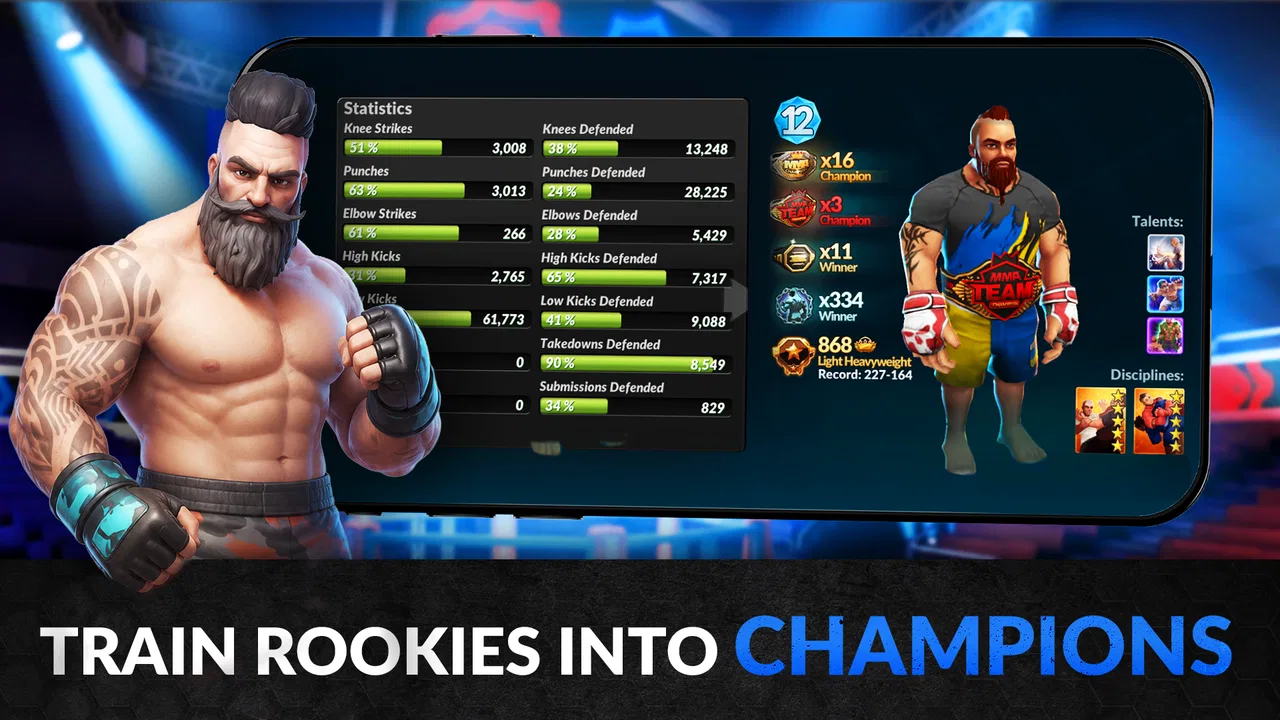
I spent time with MMA Manager 2: Boxing Training as a sports management game rather than treating it like a traditional button-mashing boxing title. Its appeal comes from making decisions around fighters, training, and the gym itself, then watching those choices shape your progress. That difference matters: if you want direct control over every punch, this may feel too indirect; if you enjoy planning a fight team and improving a training operation, it has a much stronger chance of holding your attention.
Prey Studios presents the game as a free MMA and boxing simulator for Android, and it sits comfortably between a sports strategy game and a management-focused progression game. The central fantasy is not simply winning one match. It is building a better environment for fighters, developing their skills, and making sensible choices before they enter competition. I found that structure more interesting than a short arcade session because each decision feels connected to a longer plan.
How the gym-building loop feels in everyday play
The first thing I noticed is that the game asks me to think like a coach and owner, not just an athlete. Training decisions have more importance than reflexes, and the gym becomes the place where long-term improvement is organized. That creates a useful rhythm: I check what needs attention, decide where to invest time and resources, and then prepare for the next challenge instead of immediately jumping into another fight.
You May Also Like

 Google Keep - Notes and lists
Google Keep’s Quiet Growth Shows the Appeal of Simpler Notes
As mobile work gets busier, Google Keep keeps winning a simple contest: capture a thought quickly, find it later, and get on with the day.

 Blood Strike: 2.5 Anniversary
Blood Strike’s Loadouts Turn Every Drop Into a Tactical Gamble
A close look at Blood Strike’s custom loadouts: how fast access to signature weapons reshapes its battle royale rhythm, rewards preparation, and narrows the gap between fights.

 Pandora - Music & Podcasts
Pandora’s Music Is Easy to Start, but Harder to Recover
Pandora’s strength is its low-effort path from a seed to a station. Its weak spot is how much confidence it asks you to place in connection, setup, and quiet recovery.

 8 Ball Pool
 Is Built on Rivalries, Rematches, and Routine
A close look at the rivalries, rematches, shared routines, and unanswered safety questions that turn a quick pool match into a persistent mobile community.

 Samsung Music
’s Quiet Strength Is Playing What You Already Own
Its reach comes less from spectacle than from dependable access to a personal library. That simplicity is both the app’s strongest retention engine and its ceiling.

 AccuWeather: Weather Radar
AccuWeather Review: A Quick, Clear Forecast for Everyday Decisions
For everyday plans, the best forecast is the one you can understand quickly. AccuWeather makes rain timing, radar, and local conditions easy to act on, with a few trade-offs.
More From Our News Desk



This makes it a good choice for short visits during a normal day. I can open it while waiting for a bus, review the state of my gym, make a training decision, and leave without needing a long uninterrupted session. Later, I can return with a clearer idea of what I want to improve. The game works best when I treat it as a continuing project rather than something I must finish in one sitting.
The training side also gives the game its personality. A fighter is not merely a name on a roster; the point is to shape development through preparation. That encourages me to consider whether I am chasing immediate results or building a more reliable team over time. In practice, this means resisting the temptation to make every decision for the next match alone. A short-term choice may help today while leaving the broader gym less balanced.
One useful habit is to keep a simple priority in mind before spending effort: improve the area that is holding back the next stage of progress, rather than automatically choosing the most attractive upgrade. That sounds obvious, but management games often reward players who notice bottlenecks. In this one, I found it more satisfying to ask what my gym actually needed than to upgrade whatever became available first.
The presentation is approachable, but the underlying appeal is still strategic. The game does not depend on complicated terminology to make the player feel involved. Instead, it turns familiar combat-sports ideas—training, preparation, gyms, and bouts—into a progression loop. That makes it easier to recommend to someone who likes boxing but does not want the demanding controls of a full fighting game.
What progress feels like after the opening hours
Progress is enjoyable because it gives ordinary management choices a visible purpose. Improving the gym is not just decoration in my experience; it represents a commitment to making future training more effective and keeping the operation moving forward. The best moments come when several small choices finally produce a fighter or team that feels more prepared than before.
There is also a natural pressure built into this format. A management game can make every resource feel valuable, especially when several areas appear to deserve attention at once. I had to accept that I could not improve everything immediately. That limitation is part of the challenge, but it can also become tiring if I approach the game expecting constant, effortless advancement.
For an everyday scenario, imagine checking the game after work. You have a fighter who needs development, a gym that could benefit from attention, and a future bout that makes one weakness more urgent than another. The most useful session is not necessarily the longest one. It is the session where you identify the priority, make a deliberate adjustment, and stop before turning the game into repetitive busywork.
That workflow is one of the less obvious strengths here. I get more from the game when I make decisions in batches: review the whole gym, choose a training direction, then return later to judge whether that choice helped. Constantly reopening the game just to make isolated changes can make the experience feel more demanding than it needs to be.
Where the pressure can become frustrating
The same progression design that gives the game purpose can create friction. Players who prefer immediate action may find the management layer slow, particularly when they want to feel the excitement of a fight rather than think about preparation. The game’s value depends on whether you enjoy the decisions surrounding competition. Without that interest, the waiting and planning can feel like obstacles between you and the sport.
Free access also deserves a realistic explanation. The game is free to download, but it includes optional in-app purchases ranging from $0.99 to $199.99 per item. That range is important because it means the spending environment can extend from a small convenience purchase to a very substantial one. I would approach the game with a personal spending limit decided before playing, especially if progression pressure makes a purchase look like the easiest solution.
I did not treat the presence of purchases as proof that the game is unfair. That conclusion would go beyond what can responsibly be established here. What I can say is that the available purchase range makes self-control part of the experience. If you dislike games that place paid options beside progression, even a well-designed management loop may not feel comfortable.
A practical approach is to play the early game without spending and decide whether the basic planning loop is enjoyable on its own. If the gym-building decisions are not satisfying before a purchase, paying is unlikely to solve the underlying problem. On the other hand, if you enjoy the structure and simply want to support your continued play, a small, deliberate purchase is easier to evaluate than spending reactively after a disappointing result.
Fairness, competition, and the right expectations
The word “competitive” can mean different things in a sports game. Some players want a precise contest of timing and skill, while others enjoy competing through preparation, roster choices, and long-term management. MMA Manager 2: Boxing Training is much closer to the second group. Its fairness should therefore be judged by how clearly management choices lead to outcomes, not by whether it offers the same kind of control as a conventional fighting game.
I would not choose it as a replacement for a head-to-head boxing game built around manual movement and strikes. Those games test reactions directly. Here, the satisfaction comes from deciding how to develop a fighter and how to run the gym. That makes the experience less about proving that I can execute a perfect combination and more about proving that I can make a sound plan.
The purchase information also means that players should separate personal competition from spending competition. A player who wants a purely equal-feeling environment, with no paid options influencing the surrounding progression experience, may prefer a premium sports game instead. Someone comfortable with a free-to-play structure can still enjoy this title, but should keep a clear boundary between optional spending and genuine interest in the game.
My strongest fairness-related advice is to avoid judging your progress only by the fastest possible route. Management games often become less enjoyable when every delay is treated as a problem that must be removed immediately. If you allow the gym to develop at its own pace, you can evaluate your decisions more honestly. If you feel pushed to pay simply to restore enjoyment, that is a sign to step away rather than continue automatically.
The game has attracted a substantial audience, with over a million installs, and its average rating is 4.5 from around 45 thousand ratings. Those figures suggest that the core idea works for many players, but they should not replace personal judgment. A popular sports manager can still be the wrong fit for someone who wants direct fighting controls or a fully paid experience without optional purchases.
Device requirements and practical fit
The game supports Android 8.0 and later, which makes it accessible to many Android users who are not running the newest software. I would still consider the age and condition of a device before committing to long sessions, because management games can become less pleasant when menus feel slow or the phone struggles with general performance. The operating-system requirement is straightforward, but the quality of play also depends on the individual handset.
It is rated Teen, so parents and younger players should consider that age guidance before installing. That rating is another reason not to present the game as a universal family sports title. The boxing and MMA setting may appeal to older children and adults, but the appropriate audience should be decided with the rating in mind.
The current version is 1.20.6. I would keep the app updated through the normal store process, particularly for a game built around ongoing progression. Version details matter more in a management game than they might in a one-off offline title because players tend to return repeatedly and build a continuing save.
On iOS, I would not assume the same availability or requirements without checking the relevant store page for the device in question. The Android details make the platform fit clear for compatible phones, while a careful buyer should verify the exact version and compatibility shown for any other platform before planning to play there.
Who should play it, and who should skip it
I recommend it to players who enjoy sports strategy, gradual improvement, and the feeling of running a small combat-sports operation. It is especially suitable for someone who likes checking a team, identifying weaknesses, and making several modest improvements instead of relying on one dramatic action. Fans of management games who are curious about boxing or MMA should find the theme more engaging than a generic business simulator.
I would also recommend it to a player who wants a free starting point and is willing to decide independently whether optional purchases are worth considering. The free entry makes experimentation easy, while the purchase range means the player should remain deliberate about spending.
I would skip it if your main goal is manual boxing. You will probably be happier with a game centered on direct controls, timing, and physical execution. I would also skip it if you strongly dislike progression systems that can create pressure to improve a roster or gym over time. Even when the management decisions are enjoyable, they are still the heart of the experience rather than a small side feature.
It is not the best choice for someone seeking a quiet, fully predictable premium game with no commercial distractions. A paid alternative may be better for that person, even if it offers fewer long-term management layers. Conversely, a conventional arcade fighter may be better for short bursts of action, while this game is better for returning to a developing project.
Details I would check before committing
There are a few questions I would answer through personal testing rather than assumptions. First, decide whether the training and gym decisions remain interesting after the novelty of the combat-sports theme fades. The store summary explains the premise, but the real test is whether you enjoy making repeated development choices.
Second, decide how you feel about the purchase structure. The game costs nothing to download, but individual in-app purchases can reach $199.99. That is not a reason to condemn the game, yet it is a reason to turn off impulsive buying habits and establish a limit. Players who share a device with children should be especially careful with account and purchase settings.
Third, consider whether your preferred play style is patient. The strongest workflow is to plan, make a focused adjustment, and give the result time to matter. If you need each session to deliver immediate action or a dramatic reward, the management loop may feel underwhelming.
Finally, remember that a rating of Teen is part of the practical decision. The game’s sports theme may sound familiar, but the age guidance should still be respected. These questions are more useful than simply asking whether the title is “good,” because the answer depends heavily on how you feel about planning, progression, and optional spending.
My verdict after weighing the whole package
My overall impression is positive, with an important qualification: this is a boxing and MMA management game first. I enjoyed it most when I treated the gym as a long-term project and made choices with a clear purpose. The combination of fighter development and gym improvement gives the sports setting more depth than a simple match simulator, and it provides a reason to return beyond playing one bout.
Its limitations are equally clear. It will not satisfy players looking for direct punch-by-punch control, and the free-to-play purchase range requires a sensible spending boundary. The progression can also feel pressuring if I measure success only by speed. Those are not minor details; they determine whether the game feels like a relaxing strategy hobby or another source of daily pressure.
Prey Studios has built a focused experience for people who like the decisions behind combat sports. With a 4.5 average from around 45 thousand ratings and more than a million installs, it has clearly found an audience, but I would still recommend trying the free version with realistic expectations. The fairest way to judge it is to ask whether the gym-management loop is fun before spending anything.
For me, that answer is yes. I would recommend it to a friend who enjoys sports managers, gradual training plans, and making a team better over time. I would point an action-focused friend toward a conventional fighting game instead. If you can accept the management pace, keep purchases under control, and enjoy improving a gym one decision at a time, MMA Manager 2: Boxing Training is a worthwhile free sports game to try.
FAQs for MMA Manager 2: Boxing Training
01What is MMA Manager 2: Boxing Training?
MMA Manager 2: Boxing Training is a comprehensive sports simulation game available on Android and iOS. The app allows players to manage their own mixed martial arts gym, training fighters and strategizing their careers. Players can dive into the world of MMA, focusing on training techniques, fight strategies, and gym management.
02What features does MMA Manager 2 offer?
MMA Manager 2 provides a variety of features, including fighter training and customization, gym upgrades, strategic fight planning, and competitive matches. Players can manage fighter schedules, improve skills through targeted training, and make strategic decisions to climb the ranks. The game also includes multiplayer modes for competitive play.
03Is MMA Manager 2 free to play?
MMA Manager 2 is free to download and play, but it offers in-app purchases. These purchases can enhance gameplay by providing access to premium items, faster progress, or unique customization options. Players can enjoy the game without spending money, but optional purchases can enrich the experience.
04How does the training system work in MMA Manager 2?
The training system in MMA Manager 2 is integral to fighter development. Players can choose specific areas to focus on, such as strength, agility, or technique. Balancing these aspects is essential for creating well-rounded fighters. The game offers detailed feedback on progress, allowing players to adjust strategies for optimal performance.
05What are the system requirements for MMA Manager 2?
MMA Manager 2 requires a stable internet connection and is compatible with Android devices running version 5.0 and up, and iOS devices running iOS 10.0 or later. Ensuring your device meets these specifications will provide the best gaming experience, minimizing lag and enhancing overall gameplay quality.
Pros
- Realistic training simulations enhance gameplay.
- Customizable fighters offer personalized experience.
- Engaging graphics bring fights to life.
- Strategic gameplay keeps users challenged.
- Frequent updates add new features regularly.
Cons
- In-app purchases can be expensive.
- Requires stable internet connection.
- Steep learning curve for beginners.
- Some ads can be intrusive.
- Limited offline functionality.

MMA Manager 2: Boxing Training
Gallery